My apps
Eight ways to use your phone without giving your data away. Open any of them — and if you're into tech, each one hides a "for the curious" section with its inner workings.
twice
My first operating system, written entirely from scratch with zero dependencies: a hypervisor and three kernels that turn into a private search engine for your files on the Mac. With its diploma and highest honours.

SyntheticMind
Would you tell your secrets to an AI that reports everything to a server? This one can't: it lives entirely inside your iPhone and works even in airplane mode. It answers Spanish legal questions with the actual text of the law, reads your documents, and shows the sources behind every answer. You can also try it right in your browser.

NeuroVocal Studio
Your voice says more than you think. It analyzes any audio or video and gives you a clear verdict — without your voice ever leaving your phone.

VoiceCoachAI
Hear yourself before that interview or difficult conversation: speak for a few seconds and it tells you how you sound, like a coach would.

NeoBlob
Five minutes of calm: a ball of light that follows your finger, chill music and levels that feel like little journeys. You can't lose.

NeonPulse
Looks easy: merge pieces until only one is left. The catch — the first solution you see almost never works. That's what hooks you.
Salón Recreativo
A whole arcade in your pocket: sixteen machines, each with its cabinet, its lit marquee and its high-score table. Green phosphor for the eighties ones, colour for the later ones, and a chip that synthesises the music live.

Operation Eagle Cross
An old-school vertical shoot-em-up with ten worlds and ten bosses. Hard on purpose, but never unfair: dying on stage eight doesn't send you back to stage one, and your gun starts at the level that stage expects.
MuSeA
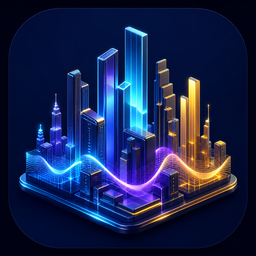
Play a track and a city built out of it appears: every instrument is a building and every note a window lighting up. It analyses the whole track inside your Mac — your music never leaves it — and then plays it back while the city moves.
Earth Twins
Of NASA's 6,336 confirmed exoplanets, how many are genuinely like Earth? Fourteen. Seven published criteria, the SQL query behind each one in plain sight so you can verify it at the source, and the habitable zone computed star by star — because it is not in the same place for all of them.